
When it comes to grey hair, clients fall into two camps – those who want to embrace their greys and those that want to cover them up.
According to recent research, 76% of women have some white or grey hair in the UK and Ireland, and the number one reason for using hair colour is to cover the greys?
Matrix Artist Ambassador Niall McNulty says a client’s main concerns are that their greys will peek through:
More than half of my clients are looking for grey coverage and they’re main concern is that it will last. They’re mainly concerned about the key focal areas, the hairline and parting. After embracing their greys during lockdown, many are ready to cover them and try something new.
So, what does Niall recommend?
When it comes to covering grey hair, first you need to discover whether your client wants full coverage, or blended coverage, which can be created using high and lowlights for a softer look. For clients wanting it all gone opaque coverage is the best technique; you need to make sure you are as close to their natural colour as possible to get the most solid coverage.
Grey hair is a combination of dark strands and white strands to make the hair appear grey. You need to determine their dark strands base and work within two levels of that depth you will achieve your best coverage.
When it comes to marketing your grey coverage services, Niall recommends looking at the wording that you use:
When you’re talking to clients about their hair you need to understand what they have in mind. Do they want their colour to be solid or blended, opaque, or translucent? This helps clients visualise and understand that there is more than one type of grey coverage and starts the conversation, as many clients have no idea the possibilities with grey coverage.
Niall’s top tips for covering greys
- Triple check you know what level your clients natural dark is. If you assume the dark strands in the hair are lighter and choose a shade more than two levels lighter than your clients natural. You run the risk of creating a more highlighted or blended result as the dark natural hair will only lift two levels when using 20volume cream peroxide.
- For a more multi-dimensional coverage, add more highlights in the areas where the percentage of natural white is greater, and less highlight and more lowlight where the percentage of white is less. This will give you a more natural grow out. And blend more then cover.
- Talk to your clients about different techniques available, they might not want something so block colour when they know what other options are available.
Products used:
- Formula A: Lightmaster with Bonder with 30 Vol Matrix
- Formula B: 10 parts SoColor Sync 7N & 5 parts SoColor Sync 7A & 5 parts SoColour Sync 7MM with 15 parts 20 Vol Matrix Developer
- Formula C: 20 parts SoColor Sync 8A, 20 parts 8V & 20 parts 10P with 60 parts 10 Vol Matrix Developer
- Unbreak My Blonde shampoo, conditioner + leave in treatment
Instruction
Hand painted formula A as a balayage from root to ends to break up previous colour and to connect the natural grey root.
Formula B was also hand painted from mid-lengths to ends to add depth and dimension and again to marry natural root to coloured ends. Toned with Formula C on pre-lightened areas and ends to create harmony between the natural and the ends ensuring a very low maintenance more natural colour that blends with the natural root as it grows out.
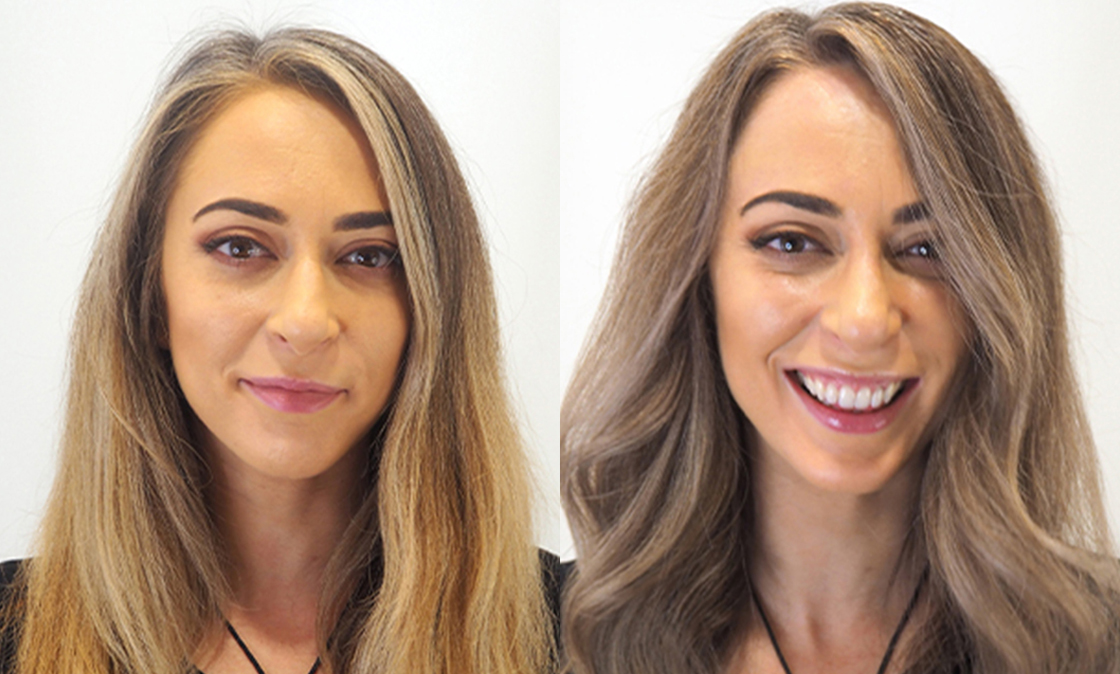
Charlotte wanted to move away from a high maintenance root colour and let her natural tones shine through, we matched up her natural colour and covered the previously coloured hair, adding a few lighter pieces around the face to seamlessly blend the two together. She wanted to embrace her greys but for her hair to still feel young and fashionable, we achieved this using balayage affect to make this cool toned grombre, that’s still on trend.
To learn more, follow @Matrix on Instagram and visit www.matrixhaircare.co.uk